


Extreme Insights
Tight Tolerances Made Simple: Choosing Between CMMs, Optical Comparators, and Height Gauges
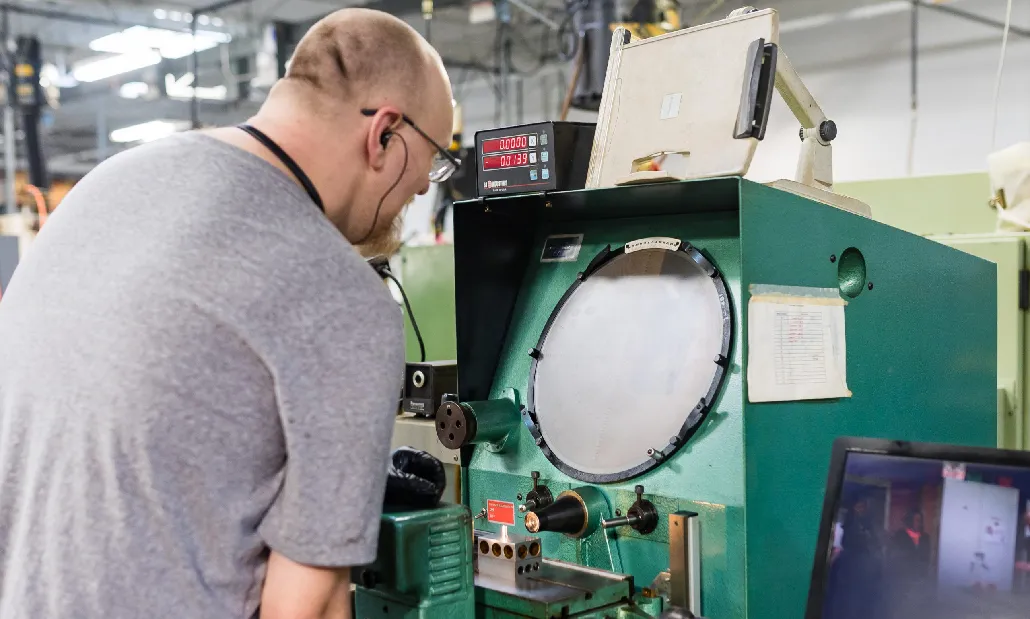
Tight tolerances are the difference between a component that performs flawlessly and one that fails in the precision machining field. If you’re building for aerospace, defense, medical, or custom automotive applications, measuring parts with extreme accuracy is non-negotiable.
At Extreme Precision Screw Products, we routinely hold tolerances down to ±0.0001″. To meet those standards, we rely on the right metrology tools for the job, primarily Coordinate Measuring Machines (CMMs), optical comparators, and height gauges.
But which tool is best for your specific inspection need? Let’s break it down.
Understanding Tight Tolerances in Precision Machining
Before comparing tools, it’s important to define what tight tolerances actually mean.
In machining, a tight tolerance typically refers to a dimensional limit of ±0.001″ or less. At EPSP, many of our aerospace and medical components demand tolerances of ±0.0005″—and sometimes as tight as ±0.0001″. At these levels, even microscopic shifts in temperature, vibration, or calibration can impact accuracy.
To ensure we meet these expectations, our Quality Assurance department uses a combination of inspection methods tailored to each part’s geometry, material, and intended use.
CMMs: Precision for Complex Geometries
Coordinate Measuring Machines (CMMs) are the gold standard for dimensional inspection when it comes to tight tolerances on 3D parts.
Best For:
- Complex geometries
- Internal features (holes, slots, pockets)
- Critical-to-function dimensions
- Automated inspection routines
How It Works:
CMMs use a tactile or non-contact probe to map a part’s surface against its CAD model or blueprint. The machine measures in X, Y, and Z axes, producing highly detailed data down to microns.
 At EPSP, our CMM is calibrated to industry standards and routinely used on aerospace, firearm, and medical parts where consistency and traceability are essential.
Pros:
- Extremely accurate
- Repeatable results
- Capable of measuring internal and external features
- Excellent for documentation and reporting
Cons:
- Slower than other methods
- Requires programming and setup
- Costly upfront investment
If your part has intricate features or you need full inspection reports for regulatory compliance, CMMs are the go-to solution for ensuring tight tolerances.
Optical Comparators: Fast, Effective Visual Inspection
Optical comparators—also known as profile projectors—are ideal for parts where rapid visual inspection of 2D profiles is key.
Best For:
- Flat or symmetrical parts
- Threads, grooves, and tapers
- Quick first-article inspections
- High-mix, low-volume jobs
How It Works:
A part is placed on a stage and illuminated from below. The profile is projected onto a screen and magnified. Operators overlay digital or physical templates to compare dimensions, angles, and shapes.
 At EPSP, we use optical comparators to quickly inspect tight tolerances on small, high-precision components like screws, pins, and threaded parts.
Pros:
- Fast and intuitive
- Great for profile inspection
- Ideal for small components
- Cost-effective for many shops
Cons:
- Limited to 2D measurements
- Operator-dependent
- Not ideal for internal features
If you’re checking thread pitch or confirming the angle of a taper, an optical comparator offers a fast and reliable way to confirm tight tolerances without tying up a CMM.
Height Gauges: Reliable for Vertical Dimensions
Height gauges remain a staple in many QA departments due to their simplicity, speed, and versatility.
Best For:
- Measuring step heights or hole locations
- Verifying vertical dimensions
- Simple setups with tight vertical tolerances
How It Works:
The gauge slides vertically along a granite surface plate. A probe or scribe measures heights from the surface up to a specific feature. Digital models improve accuracy and repeatability.
 EPSP uses height gauges to quickly verify vertical dimensions during in-process inspections, especially on turned components where stack-up accuracy is critical.
Pros:
- Easy to use
- High resolution
- Cost-effective
- No programming required
Cons:
- Limited to 2D measurements
- Requires flat reference surface
- Less suitable for complex parts
When combined with go/no-go gauges or pin gauges, a height gauge can provide fast, accurate checks for tight tolerances in less complex part features.
Choosing the Right Tool for Your Tight Tolerance Needs
Here’s a quick visual comparison to help you decide:
| Tool | Ideal For | Accuracy | Limitations |
|---|---|---|---|
| CMM | Complex 3D parts | ±0.0001″ or better | Slower, requires setup |
| Optical Comparator | 2D profiles and threads | ±0.0002″ typical | Limited to visible surfaces |
| Height Gauge | Vertical distances and hole height | ±0.0002–0.0005″ | Flat surfaces only, no internal features |
If you’re not sure which method is best, our QA team at EPSP is always happy to consult. We tailor inspection to your part’s tolerances, geometry, and function, ensuring accuracy without overcomplicating the process.
EPSP’s Commitment to Tight Tolerance Verification
At Extreme Precision Screw Products, we don’t just machine to tight tolerances—we prove it. Every part that leaves our floor is measured using calibrated equipment, operated by experienced technicians, and backed by process control that’s rooted in decades of experience.
Whether we’re producing precision screws, aerospace components, or custom tooling, we match the right metrology tool to the job. This ensures that we hit your critical dimensions without adding unnecessary cost or delay.
Our investments in Quality Assurance equipment and personnel reflect one thing: when you’re working with tight tolerances, there’s no room for guesswork.
It’s Not Just the Tool, It’s the Process
Choosing between a CMM, optical comparator, or height gauge isn’t just about specs, it’s about application. The best inspection strategy considers the part’s geometry, the required tolerances, and the production environment.
At EPSP, we bring more than just advanced equipment. We bring the judgment and experience to use them effectively. That’s what ensures your tight tolerances are met, every time.
If you’re building a high-performance firearm part or a flight-critical aerospace component, you can trust EPSP to measure up.
Need help with a tight-tolerance part? Contact our team at EPSP to discuss your inspection requirements and how we can help.
